As of 2025, conflicts continued to intensify and spread across regions, fracturing communities and placing immense strain on already fragile health systems. In these environments, the role of community health workers (CHWs) became even more vital. The plenary on CHWs in conflict-affected settings explored how conflict transforms community health work, what CHWs are able to do under such conditions, and what additional support they require to continue delivering essential care to the people who rely on them.
Across diverse contexts, CHWs remained the most trusted and accessible link to care when health facilities closed, supply chains broke down, or insecurity limited access. Despite threats to their own safety, trauma, displacement, and severe resource shortages, they continued to provide services that saved lives. The session highlighted how CHWs operate under extraordinary pressures because they are both responders and members of the affected communities. This dual position made them uniquely effective but also uniquely vulnerable, and their role remained under-recognized within global health, humanitarian, and policy frameworks.
Speakers emphasized the need for stronger protection, investment, and integration of CHW voices in peacebuilding and recovery processes. The discussion called for policy and operational reforms that would ensure the safety, recognition, and long-term sustainability of CHWs and community health systems in conflict-affected and fragile environments. Through stories from the field and reflections from experts, the plenary underscored that supporting CHWs is not only a health priority but also a critical contribution to community stability and resilience.
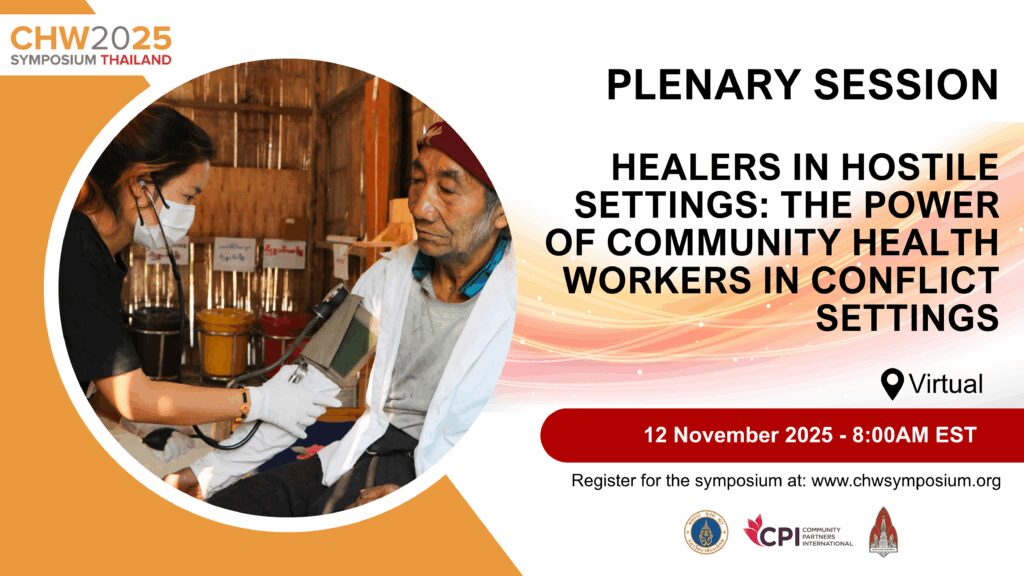
Healers in Hostile Settings: the Power of Community Health Workers in Conflict Settings
12 November 2025, 08:00pm – 09:30pm UTC+7
Speakers:
- Jo Raven is a Professor in health systems research, co-director of the Institute for Resilient Health Systems, and Deputy Head of International Public Health at the Liverpool School of Tropical Medicine in the UK. Jo has over 25 years’ experience of research, training and partnerships in Africa and Asia. Her research has focused on health systems in fragile and conflict-affected settings particularly in the areas of health workforce and community health workers. She is the co-lead for the ReBUILD for Resilience programme which focuses on the health system’s resilience in fragile and shock prone settings.
- Dr. Mitzu is a medical doctor and public health specialist dedicated to building sustainable local workforces, including community-based organizations, civil society groups, and frontline health workers. For nearly a decade, she has worked in conflict-affected areas of Myanmar, focusing on strengthening local systems and organizational resilience. As one of the frontline responders during the 2025 Mandalay earthquake, Dr. Mitzu brings valuable insights from her experience collaborating with diverse community health worker task forces through community based organizations in crisis response and recovery.
- Emily Ruth is the President of the Karenni Nurses Association (KNA), a community-led health network founded by Civil Disobedience Movement nurses in Myanmar’s Karenni State after the 2021 coup. Under her leadership, KNA has built 45 clinics serving 150,000 displaced people through community health workers, nurses, and midwives. Her presentation, “Grassroots Health Leadership in Conflict Setting: The Karenni Nurses Association’s Three-Year Journey,” highlights how nurse- and CHW-led systems can sustain essential health services and governance in crisis-affected areas.
- Aya Abu-Miriam is currently displaced from the Tulkarem Refugee camp alongside 30,000 residents where the Israeli military has taken over the camp for almost a full year. She completed her studies in nursing and joined the Health4Palestine – Tulkarem program when it started last November.
- Aya Darwish from Al-Malha village, but lives in Aida Camp in Bethlehem, Palestine. She is the Coordinator of the Health and Environmental unit at Lajee Center. She studied in the medical laboratory in the Ramallah Women’s Training Center, and is continuing my education in Counseling and Mental Health studies at Al Quds University.
- Bram Wispelwey is an internal physician at Brigham and Women’s Hospital. He is a Co-founder and Chief Strategist of Health for Palestine. Dr. Wispelwey’s research focuses on structural racism in hospital triage, ethics, community health worker impact, social and political barriers to health, and colonial violence.
- Allaye Djibo has served as a Professional Community Health Worker (ProCHW) in Bankass District, central Mali, since 2017. Before taking on this role, he worked as a data collector for the NGO Livestock for Growth. Motivated by a desire to support his community more directly, he transitioned to the ProCHW role and has since become a trusted frontline provider. Allaye currently delivers essential care to nearly 200 families in the Doundé health area, experiencing firsthand the impact of conflict on the local health system and the importance of maintaining access to care.
- Dr. Djoumé Diakité is a primary care physician who earned his MBBS from the University of Bamako Faculty of Medicine and a diploma in Global Health Delivery from the Harvard T.H. Chan School of Public Health. Prior to Muso, he served as Medical Director of a community health center in northern Mali and worked as a clinical telemedicine specialist with the International Institute for Communications and Development.
As a co-founder of Muso, Dr. Djoumé has been a key architect of the organization’s Rapid Care model. Dividing his time between the office and the field, he has developed a deep understanding of the daily realities faced by Muso’s Professional Community Health Workers (ProCHWs) and the communities they serve. He also works closely with government partners at local, regional, and national levels to strengthen health systems and expand access to care.
This session was moderated by Tom Traill of Community Partners International (CPI)
