In 2025, global health funding shifted in ways that directly affected the most vulnerable communities and the community health workers (CHWs) who supported them. As the 4th International CHW Symposium opened, this first plenary set the tone by acknowledging these challenges while asking what new possibilities had emerged and how resilience could guide the way forward.
This plenary session explored the current state of the world through a series of focused panel rounds. Speakers reflected on what had changed since the 2023 Monrovia Call to Action and shared perspectives on national responses, political momentum, and the evolving role of coalitions. They also discussed how shifts in financing and new global health operating models were influencing the prioritization of CHW roles. Later rounds turned toward cooperation, reforms, and the shared responsibilities of governments and partners in the context of growing conflict, migration, and exclusion. The final reflections asked panelists and the audiences to look ahead and identify one hope for progress by the 5th CHW Symposium.
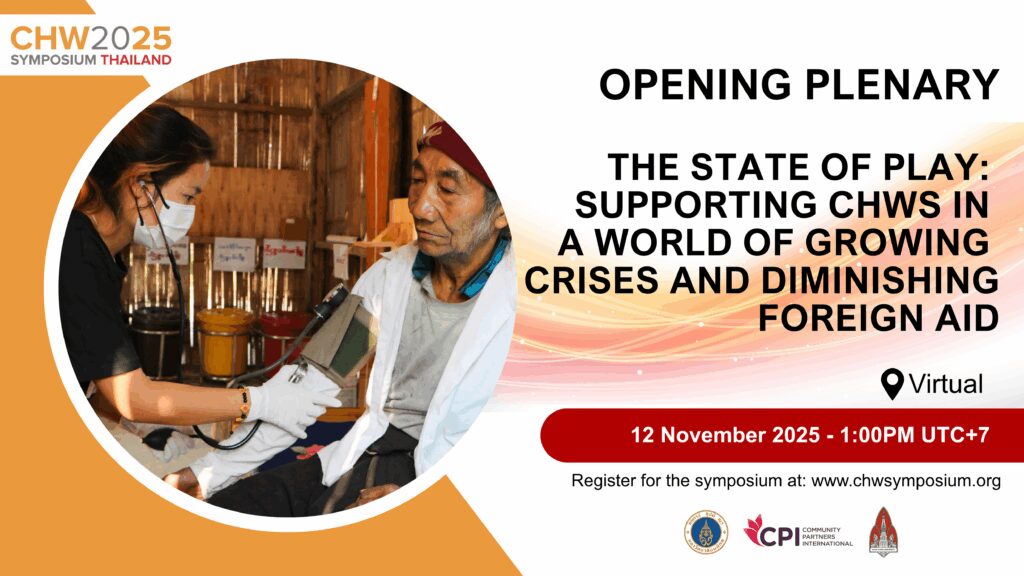
The State of Play: Supporting CHWs in a World of Growing Crises and Diminishing Foreign Aid
12th November 2025, 13:00-14:30pm UTC+7
Speakers:
- Dr. Si Thura, CEO at Community Partners International (CPI), joined relief and recovery efforts in the Ayeyarwady Delta after the devastation caused by Cyclone Nargis shortly after his graduation from medical school in 2008. The experience convinced him that the key to the future was to strengthen resilience and support the development of community-led services to provide for essential needs such as health care and education. Dr. Si Thura joined Community Partners International (CPI) in 2009 as the organization’s first Myanmar-based staff member. Starting from a small office in Yangon, Dr. Si Thura has played an instrumental role in bringing CPI from its roots on the eastern border to the forefront of health systems in Myanmar, especially for health reforms.
Dr. Si Thura received the 2013 Australian Leadership Award and 2016 InsideNGO’s Emerging Leader Award. He is also a co-founder and Joint Secretary of the Liver Foundation (Myanmar). - Dr. Madeleine Ballard is the CEO of Community Health Impact Coalition (CHIC), a global movement for professional community health workers that’s changing guidelines, funding and policy. Her work at the Coalition was awarded the Roux Prize (2024) and the Skoll Award for Social Innovation (2025), and has been featured in the New York Times, Forbes, Foreign Policy, and Lancet Global Health. Dr. Ballard earned her PhD from the University of Oxford as a Rhodes Scholar, is the recipient of the Harvard Women’s Leadership Award, and co-founded the Anti-Racism Task Force at the Arnhold Institute for Global Health of the Icahn School of Medicine at Mount Sinai, where she is on faculty.
- Margaret Odera is a dedicated community health worker and mentor mother at Mathare North Health Center, where she supports her community through mobilization, referrals, and follow-ups. As a mentor mother, she plays a vital role in preventing mother-to-child transmission of HIV, drawing from her own experience raising three HIV-negative sons through Kenya’s PMTCT program. Her work reflects the program’s broader success, which has helped reduce HIV positivity among infants to below two percent.
Beyond her daily duties, Margaret is a leading advocate for the professionalization and fair compensation of CHWs. She founded the CHW Champions Network, now uniting over 6,000 CHWs across all 47 counties, and has contributed to major policy milestones, including the passage of the CHS Bill recognizing CHWs in Kenyan law. Her impact has earned multiple honors, such as Heroine of Health (2022), the CORE Group Community Health Champion Award (2024), and the Skoll Award for Social Innovation (2025), which she accepted alongside CHiC in Oxford.
- Dr. Landry Dongmo Tsague is the inaugural Director of the Africa CDC’s Center for Primary Health Care, leading continental efforts to strengthen PHC systems as the foundation for Universal Health Coverage and health security in Africa. His role places him at the forefront of advancing resilient and self-reliant health systems tailored to the continent’s needs. He oversees a wide portfolio that includes community health, maternal and child health, immunization, nutrition, HIV/TB, malaria, noncommunicable diseases, injuries, and mental health, and works closely with African Union Member States and global partners to implement Africa CDC’s Strategic Plan and the Lusaka Agenda.
- Dr. Mickey Chopra is currently the Global Solutions Lead for Service Delivery in the Health Nutrition and Population global practice of the World Bank. He leads its work around the organization, management and quality of health services. Previous to this he was the Chief of Health and Associate Director of Programs at UNICEF’s New York Headquarters.
Additionally, he has chaired the Evaluation and Research Group at the Global Fund for HIV/AIDS, TB and Malaria to ensure that their investments are reaching those most in need and chaired the Special Committee for Large Countries for GAVI that worked on ensuring increased coverage of vaccines for Nigeria and India in particular. He led the technical team that oversaw the UN Commission on Essential Medicines and Commodities.
- Natalie Mrak is currently Associate Director of External Affairs for the Global Health Equity (GHE) team at Johnson & Johnson, where she supports engagement with global organizations as well as advocacy efforts across focus areas, including health workforce. Natalie has 15 years of experience working in global health, in the private and multilateral sectors. Previously, she worked in the access to health team of a science and technology company where she was the lead for strategy and partnerships in low and middle income countries in addition to several years in Programme Division at UNICEF HQ in New York. Natalie has a Master’s in Development Studies from the Graduate Institute Geneva (Switzerland), where she concentrated on Global Health and the role of emerging economies.
- Dr. Nicholas Oliphant is currently the Senior Specialist for Community Health Programming in the Resilient and Sustainable Systems for Health (RSSH) Team of the Technical Advice and Partnerships Department of the Global Fund. He leads its work on Community Health Workers. Previous to this he was the Senior Specialist for Malaria High Burden High Impact in the Malaria Team of the Technical Advice and Partnerships Department of the Global Fund and Health Specialist with UNICEF. Dr. Oliphant has a PhD from the University of the Western Cape, South Africa and an MPH from Tulane University, United States of America.
- Dr. David Musoke is an Associate Professor of Public Health at Makerere University School of Public Health, Uganda. He is an Affiliate Member of the African Academy of Sciences and Fellow of the Uganda National Academy of Sciences. Dr. Musoke spearheaded organizing the 1st International CHW symposium that was held in Kampala, Uganda in 2017 and has been instrumental in having these symposia held biennially in various countries around the world.
- Dr. Thunwadee Suksaroj is an Associate Professor and Director of the ASEAN Institute for Health Development, Mahidol University, Thailand, and serves as Executive Secretary of the ASEAN University Network- Health Promotion Network (AUN-HPN). She holds a Doctor of Science in Industrial Science and Biological Process (Food Science) from Université Montpellier, France. Her expertise lies in environmental technology, biotechnology, and environmental health, with research focusing on sustainable development, wastewater treatment, and the circular economy. A certified Carbon Footprint Assessor and consultant in cleaner production, Dr. Suksaroj has published widely and fosters international collaborations to advance sustainable health and environmental resilience in Asia.
- Dr. Wongsa Laohasiriwong is a Professor and the Dean of the Faculty of Public Health at Khon Kaen University, Thailand. She serves in several key leadership roles, including as a member of the University Council and Secretary General of the Greater Mekong Subregion Public Health Academic Network. She also contributes to the Asian Health Literacy Association and is President of the Council of Deans of Faculties of Public Health of Thailand. Her academic expertise includes health impact assessment, health policy development, evaluation research, health service systems, health security, mental health, non-communicable diseases, and HIV/AIDS and tuberculosis.
This session is moderated by Nazo Kureshy
Background
The opening plenary aimed to set the tone for the 4th International Community Health Workers (CHW) Symposium by recognizing the extraordinary resilience and commitment of CHWs working in today’s most challenging contexts. Across the world, CHWs, often at great personal risk, continue to serve communities affected by conflict, migration, and exclusion. At a time when global instability, displacement, and climate shocks are redefining the boundaries of health and humanitarian work, CHWs remain a constant source of trust and stability at community level. They are not only service providers but also agents of hope who bridge communities and systems together – they ensure continuity of care when institutions falter. This session was designed with a “state of the world” perspective, providing the global backdrop of crises and inequities that shape community health today.
Session Objectives:
- To appreciate and honor CHWs in contexts of conflict, crisis, exclusion, and migration by recognizing their courage, resilience, and vital contributions to community health.
- To situate this appreciation within today’s global realities, connecting moral recognition with policy and collective action toward more equitable and resilient health systems.
